Before going to know the lifecycle of DevOps, let us first discuss to need for DevOps. What is DevOps? Why DevOps culture is implemented in companies?
The Need for DevOps
Development of an application is not as simple as people think. As everybody knows after development, the application needs to go under the testing phase. And we can predict the time required for the project to get into production. In some cases, it goes on time back for the purpose of development and in some cases, it goes many times. So it means it’s a time-consuming process. So as an alternative, we need a process that delivers the project in a short span of time. So there comes a need for DevOps
DevOps is basically a combination of two words, “development” and “operations.” Usually, DevOps is a culture that follows the set of practices to combine the DevOps and IT, operation teams. Its major goal is to shorten the system delivery life cycles. This culture increases the organization’s speed to deliver applications and services.
Where to Apply the DevOps Culture?
Devops is applied for the large distributed platform such as e-commerce sites (or) application on a cloud platform.
DevOps Lifecycle
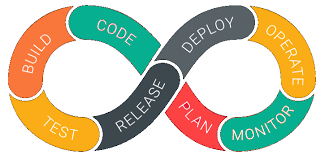
The DevOps life cycle comprises of different stages. Let me explain them to you in detail.
Plan: Initially plan yourself regarding the type of application you need to develop. Make the rough picture regarding the development process
Code: Code the application as per the client requirement. with the plan, you have made in the initial step.
Build: Build the application by performing the integration of various codes you have done in the previous step.
Test: This is the heart of the application. Test the application that you have built so far. And the rebuilt the application if necessary.
Releases: If you succeed in the Test phase, then its time to release the application into Live.
Deploy: Deploy the code into a cloud environment for further usage. It is performed in such a manner any changes made should not affect the functioning of high traffic website.
Operate: Perform the operation on the code if any have.
Monitor: Monitor the performance of the application as per the client requirement. Keep a note on the performance of the application. Make modifications if any to satisfy the clients. And if does not reach up to the mark make changes in that particular area to satisfy the client.
And in this way, the lifecycle of the DevOps goes on.
And in the current IT industry, this DevOps platform has a high demand in the IT market. In year 2020, DevOps Certification has a high demand in the IT market. And today through DevOps Training, we can easily get certified on DevOps. Because on the top of DevOps we do have several tools which have a demand in the IT market.
Technology has evolved over time. And with technology, the ways and needs to handle technology have also evolved. The last two decades have seen a great shift in computation and software development lifecycles. We have seen a huge demand for online DevOps training and AWS certification.
This blog focuses on the following points:
What Is DevOps?
What Is AWS?
AWS DevOps
What Is DevOps?
In these fast-paced times, we see more emphasis being placed on faster delivery of software deployment. In order to stay competitive in the market, companies are expected to deploy quality software in defined timelines. Thus, the roles of software developers and system admins have become very important. A lot of juggling of responsibilities happens between the two teams. Let us take a look at how do these individuals contribute to the deployment process.
A programmer or a software developer is responsible for developing the software. In simple words he is supposed to develop a software which has:
New features
Security Upgrades
Bug Fixes
But a developer may have to wait for weeks for the product to get deployed which is also known as “time to market” in business terms. This delay may put pressure on the developer because he is forced to re-adjust his dependent activities like:
Pending code
Old code
New products
New features
When the product is put into the production environment, the product may show some unforeseen errors. This is because the developer writes code in the development environment, which may be different from the production environment.
Let us go ahead and take a look at this process from the operations point of view. Now the operations team or the system administrating team is responsible for maintaining and ensuring the uptime of the production environment. As the company invests time and money in more products and services, the number of servers admins have to take care of also keeps growing.
This gives rise to more challenges because the tools that were used to manage the previous number of servers may not be sufficient to cater to the needs of upcoming and growing number of servers. The operations team also needs to make slight changes to the code so that it fits into the production environment. Hence, the need to schedule these deployments accordingly also grows, which leads to time delays.
When the code is deployed, the operations team is also responsible for handling code changes or minor errors to the code. At times, the operation team may feel pressured and it may seem like developers have pushed their responsibilities to operations’ side of the responsibility wall. As you may come to realize, none of the sides can be held as the culprit.
What if these two teams could work together? What if they:
Could break down silos?
Share responsibilities?
Start thinking alike?
Work as a team?
Well, this is what DevOps does. It helps you get software developers and operations in sync to improve productivity. DevOps is the process of integrating development and operations teams in order to improve collaborations and productivity. This is done with automation of workflows and productivity and continuous measurement of application performance.
DevOps focuses on automating everything that lets them write small chunks of code that can be tested, monitored and deployed in hours, which is different from writing large chunks of codes that takes weeks to deploy. Let us move ahead and understand more about AWS and how it forms a crucial pairing with DevOps to give you AWS DevOps.
What Is AWS?
If you go back a decade, the scenario of handling and storing data was different. Companies preferred storing data using their private servers. However, with more and better usage of the internet, the trend has seen a paradigm shift for companies, as they are moving their data to the cloud. This enables companies to focus more on core competencies and stop worrying about storing and computation.
For example, Netflix is a popular video streaming service which the whole world uses today. Back in 2008, Netflix suffered a major database corruption, and for three days their operations were halted. The problem was scaling up, which is when they realized the need for a highly reliable, horizontally scalable, distributed systems in the cloud. They began using cloud services, and since then their growth has been off the charts.
Gartner says that by 2020, a corporate “no-cloud” policy will be as rare as a “no-internet” policy today. Interesting, isn’t it?
Almost every company has started to adopt cloud services, and AWS, in particular, is the leading cloud service provider in the market. Let us understand more about it.
AWS
Amazon’s AWS makes its customer base strong from small-scale companies to big enterprises like D-Link.
AWS DevOps
AWS is one of the best cloud service providers and DevOps is the popular and efficient implementation of the software development lifecycle, making AWS DevOps a highly popular amalgamation.
AWS CloudFormation
DevOps teams are required to create and release cloud instances and services more frequently than traditional development teams. AWS CloudFormation enables you to do just that. Templates of AWS resources like EC2 instances, ECS containers, and S3 storage buckets let you set up the entire stack without you having to bring everything together yourself.
AWS EC2
AWS EC2 speaks for itself. You can run containers inside EC2 instances, so you can leverage the AWS Security and management features, yet another reason why AWS DevOps is a lethal combo.
AWS CloudWatch
This monitoring tool lets you track every resource that AWS has to offer. Plus it makes it very easy to use third-party tools for monitoring.
AWS CodePipeline
CodePipeline is one popular feature from AWS which simplifies the way you manage your CI/CD toolset. It lets you integrate with tools like GitHub, Jenkins, and CodeDeploy, enabling you to visually control the flow of app updates from build to production.
Instances In AWS
AWS frequently creates and adds new instances to their list and the level of customization with these instances allow you to make it easy to use AWS DevOps together.
All these reasons make AWS one of the best platforms for DevOps. Hence acieve your dream to become the DevOps Engineer at DevOps Training
Few of us could have predicted that data breaches would become so common and part of the major news cycle. It almost seems like there are leaks reported on a daily basis, such as compromised accounts on Facebook or credit card account leaks from major companies. With the proliferation of web and mobile apps in high abundance, there is also a constant stream of negative press related to criminals breaking into company data stores.
Fortunately, there’s one smart option for those who are concerned about deploying a new website, application, or cloud service and how that could open up an attack vector.
AWS VPC (Virtual Private Cloud) provides an isolated and secure virtual cloud for companies to deploy websites, apps, and other services. It’s a private, provisioned portion of the Amazon virtual cloud and has the extreme flexibility and scalability to help a tiny startup launch a new website or a massive enterprise deploy a new web application.
Security is a primary reason to use AWS VPC, but there’s also the flexibility to configure the virtual cloud the way you need to run it. This can include using either IPv4 or IPv6, setting your IP address range, creating subnets, and configuring gateways and route tables….
One example of how this works is with subnets. A large company might decide to use VPC because they have public-facing and private-facing applications. Launching a new rich application for consumers, they might create a subnet that is still secure and reliable. Yet they might also need a second subnet, configured according to their technical requirements, that is not available to consumers nor over the public Internet.
Get practical knowledge on AWS VPC from live experts at AWS Training
The private subnet might be intended only for a legacy backup system or a secure database used only by internal employees who access the server over a private network and not the internet. This type of control over what your web server in the cloud can do, for both public and private applications, means you can take control of your security infrastructure.
Within the subnets, you can use EC2 (Elastic Compute Cloud) instances that you deploy and control instead of relying on a data center at your own site and having to configure, maintain, and update the IT infrastructure for your various apps and data stores.
Because the VPC is all part of Amazon Web Services, you also can deploy Amazon S3 (Simple Storage Service) within each instance, and even restrict which AWS account can access the subnets. One way to understand how this all works and the benefits is to think of VPC as a private container for your web apps, each one secured and restricted in a way that reduces the chances of a data breach. You’re in full control of where the data resides within your own private cloud, which instances are deployed, and how the storage is configured.
Benefits and examples of AWS VPC
Because of all the flexibility in having your own AWS Virtual Private Cloud, companies can scale and deploy business apps and reach an audience faster, without the typical concerns over data breaches and configuring the infrastructure. Companies can deploy the VPC right from the AWS Management Console. This is all template-driven so that you can focus more on the apps, your database, and your new website rather than the complexity of configuration and setup.
As with many Amazon Web Services, the VPC also helps you reduce the costs associated with a private cloud. One example of this is when a company is faced with the need to deploy a secure disaster recovery portal. In the past, creating the infrastructure for disaster recovery is a major undertaking, especially when there are complex regulations and compliance issues involved. It is often an expensive, time-consuming endeavor. Companies know they need to plan for a major event that is weather-related (e.g., a tornado that destroys local servers) or some other catastrophic event, but actually doing so is not an easy process.
With VPC, you can use your own private cloud as a disaster recovery site for a much lower cost than doing it on your own with a second data center location. You also have the benefit of using EC2 instances to add compute performance if the primary infrastructure is not available. There are additional benefits related to extending the compute performance of an existing data center or server room, even for companies with an extensive array of web servers.
One last example of how a company might use VPC is for experimentation. Deciding to launch a new website is not typically something you can do overnight. Yet, even a small company can create business requirements, build the features and functions, and then rely on a virtual cloud for running the application without having to first make it secure and reliable.
So, you decided that AWS certification exams are worth it, and now you’re in the process of studying or are about to start studying for your first certification exam. These are the recommendations that we have based on our experience training tens of thousands of students.
1. Understand the types of questions asked and the exam format.
Before you start studying, it’s important to look at what the format of the actual exam is like. This can help give you a target to hit instead of aiming in the dark. This also gives you more peace of mind when you take the exam since you already know what to expect.
2. Break it down into manageable chunks.
Rome wasn’t built in a day and you’re not going to pass the exam if you don’t take it one step at a time. The correct training will already help you break concepts down into manageable chunks, but don’t underestimate the time it takes to study them. Allocate enough time to make sure you thoroughly understand and complete the concepts, services, and hands-on activities. Some people we train start studying after scheduling the exam date because it helps ensure they stay on track and actually study, but there is risk involved. The risk is that you end up not giving yourself enough time to study which results in cutting corners. So, I don’t particularly recommend this method. If you need accountability to stay on track, keep reading for tips on finding a study partner to hold you accountable. Now, we can move on to the next point and perhaps one of the most important points.
3. Create a detailed schedule – what will you study and when?
A detailed schedule is important for a number of reasons. First, it helps you better estimate how long your training journey will take. Second, it helps you stay accountable by visibly tracking progress. Third, it helps you get into the habit of studying at regular intervals instead of simply going with “when I have enough time.” Whether you use a course scheduler native to a training platform or your own calendar, set it up to the point where you can’t ignore it. Include details on what to study at what time and set notifications so you don’t forget. Granted, this is likely not a groundbreaking tip that you’ve never heard of, but it bears repeating because it is very important.
Get a detailed preparation plan by a certified experts at AWS Online Training
4. Find a study partner to hold you accountable.
This tip is also an important one. Just like a gym buddy holds you accountable for working out on a regular basis, a study buddy holds you accountable for studying for AWS Certification exams. The best way to find study partners is to find others in your organization who are also studying for a certification exam. Preferably the same one as you. Bonus points if you can find a study partner with complementary skills to your own. You can also find another person who has already passed the exam and can give you additional insight. If you don’t know anyone studying for certification exams, another option is to find local meetups with likeminded people. Meetups happen all over the country and in every major city, so you should have lots of opportunities to check one out. Another option would be to join Slack channels which, similar to meetups, have like-minded folks. . Finally, you can join communities and study groups on online training platforms. This may not seem as personal at first, but you are far more likely to find like-minded people here since they are in the community for similar reasons to yours. Regardless of how you find a partner, having someone to hold you accountable is a huge help when trying to pass certification exams.
5. Try to apply everything you learn – even concepts.
If you’re learning and studying to pass an AWS Certification, chances are you need practical knowledge and not just theoretical knowledge. If you only memorize the concepts and you don’t try to apply them, they won’t stick. Unless you have a memory of steel (I wish I did), you will only remember concepts and not know how to use them which won’t help you once you’re on the job. That’s why we have built a platform which guides you through the real AWS Console so that you can become a real Amazon Web Services engineer and not just a paper-certified engineer. You can read more about how Linux Academy has pushed the boundaries of online learning with Hands-On Labs and Interactive Diagrams. We don’t just want you to pass an exam and call it a day. We want you to learn how to apply skills and tools to your job and surpass your career goals.
6. When reviewing objectives focus on items you are weakest in.
Finding your weaknesses and knowing what to focus on as you near the day of the exam is something a lot of people struggle with.
“I’ve studied, but I’m not sure what to focus on now – it’s hard to tell what my weak points are or what I am missing.”
This is one of the main problems our platform solves. Whether you’re a seasoned cloud veteran trying to keep up with new features or trends or a beginner moving into a new career field, knowing where to start and knowing where to go next is a difficult challenge. Not for computers, though. Our Artificial Intelligence engine is very good at knowing what you need to focus on based on how you perform in an AWS environment. It looks at the data and makes decisions based on that data. The data tells it exactly what your weak points are and it tells you exactly what you should do next. It sounds hard to believe. I personally didn’t even know if it was possible before our team started working on the platform. Not only is it possible, but it makes perfect sense. It has to be the future of training and the future of education. It’s too efficient not to be. However, if you’re trying to figure this out manually, the best advice I can give is:
7. Find someone to teach – if you can teach it, you have learned it.
This one is self-explanatory, and you’ve probably heard the saying before. If you can explain like I’m 5, then you understand it. If you can’t, then you probably don’t understand it well enough and need to review.
There have been various exceedingly noticeable, quick moving
patterns in modern mechanization innovation in the course of recent years. The
most remarkable of these has been the Internet of Things and its related
portable and remote applications. Other prominent patterns incorporate the
ascent of increased and augmented reality and the expansion of modern cyber security
organizations.
To some degree under the radar, another pattern has been
building up: The expanding utilization of Linux as a main working framework
(OS) for robotization controllers.
A central point behind industry’s enthusiasm for Linux has
dependably been the innovation’s receptiveness. Industry’s longing to have its
innovations be not so much restrictive but rather more open—in this way
enabling organizations to choose and trade their advances all the more
effectively—is, obviously, just the same old thing new. The most forceful
industry push for open robotization innovations can be found in the exercises
of the Open Process Automation Forum.
However, in years past, advances fueled by Linux have generally been specialty items offered to speak to a little portion of the modern market with the ability and skill to buck the more broadly utilized frameworks. All the more as of late, in any case, it’s turned out to be uncommon for me to go to gatherings with innovation providers who are not uproariously touting their help for Linux with a variety of items.
So Learning this kernel is most important. And you can get the more real time knowledge through learn Linux online


 Linux updates